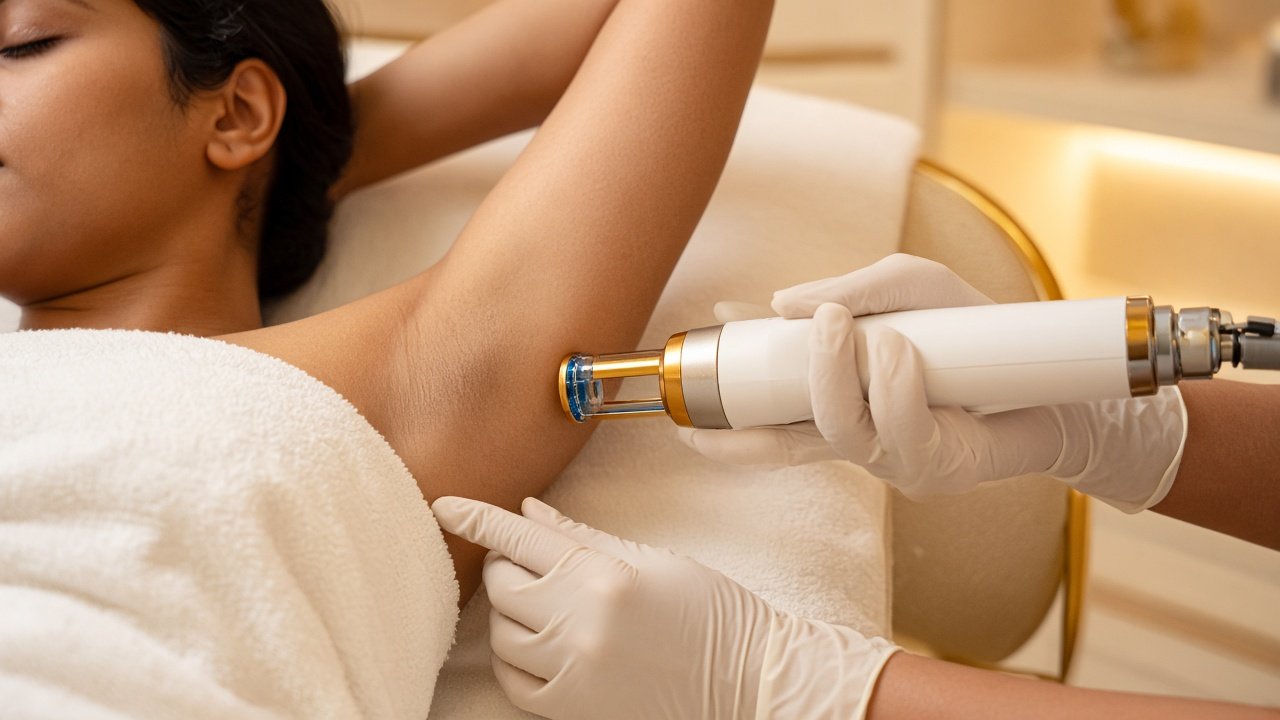
Laser hair reduction has become one of the most widely requested aesthetic procedures globally. Yet misconceptions persist regarding its mechanism, safety, and permanency, particularly for Indian skin tones.
Principle of Selective Photothermolysis
Medical hair removal lasers operate on the principle of selective photothermolysis, formulated by dermatologists Anderson and Parrish. The laser emits a specific wavelength of light absorbed selectively by melanin in the hair shaft. This light energy transforms into controlled thermal energy, damaging the follicular stem cells in the bulge and bulb without harming adjacent tissue.
Why Calibration for Indian Skin (Fitzpatrick Types III–V) Matters
In lighter skin types, melanin is concentrated solely in the hair. However, in olive and deeper Indian skin tones, the surrounding epidermis also contains significant melanin. If an inexperienced operator uses improper wavelengths (like generic IPL) or excessive energy, the epidermal melanin absorbs the light, resulting in burns, blistering, or hyperpigmentation.
At CliniKimaya+, Dr. Sneha Singh oversees laser parameters strictly utilizing longer wavelengths (such as 808nm–810nm Diode and 1064nm Nd:YAG) combined with high-grade sapphire contact cooling. Longer wavelengths bypass surface epidermal melanin and penetrate directly to deep follicular roots safely.
Pre-Session Checklist:
- No Waxing or Plucking: Avoid waxing, threading, or epilating for at least 3 weeks before your session. The hair root must be physically present inside the follicle for the laser to target it.
- Shave the Day Before: The treatment area should be freshly shaved 24 hours prior. Long surface hair will singe and dissipate energy away from the follicle.
- Avoid Sun Tanning: Keep the area protected from active tanning for 2 weeks prior to avoid heightened epidermal reactivity.